Data Solutions by Industry & Role
Data cleaning and enrichment tailored to your industry, team, and use case.
What Are Data Validation Services?
Data validation services check whether the records in your database are correct, current, and usable. A validation service takes your existing data (contacts, accounts, addresses, emails, phone numbers) and verifies each field against authoritative sources: SMTP servers for email, carrier databases for phones, USPS for addresses, state registries for licenses. What comes back is your same file with each record marked valid, invalid, or corrected.
That's different from enrichment, which adds new fields, and from cleaning, which fixes formatting and removes duplicates. Most real projects need all three, which is why this page organizes everything we do by industry, team, and use case. If you want the deeper explanation of how validation fits into a data project, start with our data validation services page or the what is data enrichment guide.
What Does a Validation Service Provider Do?
A provider runs your records through verification checks, applies human QA to the ambiguous cases, and returns a scored file. No platform to learn. No seats to license.
The reason companies outsource this instead of buying software: software validates format, a service validates truth. A regex can tell you [email protected] is shaped like an email. It can't tell you Jane left Acme eight months ago. Checking that requires cross-referencing employment signals, and that's the work a provider does for you.
Which Types of Records Can Be Validated?
Almost any field in a B2B database. The five we validate most:
| Validation type | What gets checked | Typical failure rate we see |
|---|---|---|
| Email validation | SMTP deliverability, domain-wide acceptance detection, role accounts, spam traps | Measure the submitted cohort against a dated validation run |
| Account validation | Company still operating, correct registered name, website live, right industry code | 5-10% defunct or renamed |
| Address validation | USPS standardization, deliverability, ZIP+4, company-location match | 10-20% undeliverable or moved |
| Phone validation | Carrier lookup, line type, disconnected numbers | Measure by source and record-age cohort |
| Contact-role validation | Person still at company, current title, seniority mapping | Measure change against a dated baseline instead of applying a general decay benchmark, then set the review cadence from the changes observed in your own system. |
Missing, stale, and conflicting fields can overlap on the same records, so adding separate issue rates can double-count the problem. Profile a dated CRM export at the record and field level, preserve the denominator, and report overlapping conditions explicitly.
Do You Cover US and Canadian Data?
Yes. US validation runs against USPS, state business registries, and NPI/licensing databases where relevant. Canadian records validate against Canada Post formats and provincial registries.
One disambiguation, since search engines mix these up: this page is about validating business data. If you landed here looking for "service validation and testing" in the ITIL sense (the practice of verifying that new IT services meet requirements before release), that's IT service management, and a different discipline entirely.
Solutions by Team
Sales Operations
Give your reps data worth calling
Marketing Operations
Run campaigns that deliver
Revenue Operations
Build systems that scale
Solutions by Industry
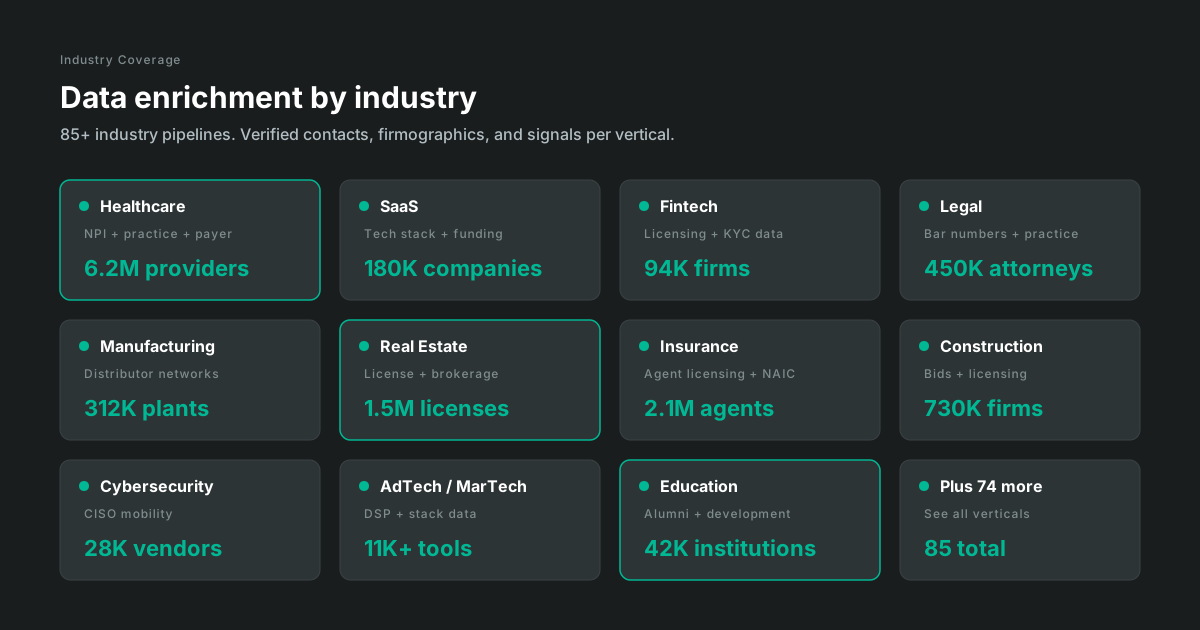
Each industry has its own data problems. Healthcare needs NPI verification, fintech needs KYC-grade correctness, and SaaS needs tech stack signals. Pick your vertical.
Industry Data Cleaning
Industry Data Analysis
By Role
Solutions by Use Case
Data Quality & Hygiene
Prospecting & List Building
Targeting & Segmentation
Analysis & Insights
Data Types We Enrich
Company Data
Technology Data
Common Questions About Validation and Data Solutions
What does "validation services" mean for B2B data?
It means verifying that the data you already have is true. Each email, phone, address, and company record gets checked against live sources and marked valid, invalid, or corrected. Validation confirms existing fields. Enrichment adds new ones.
How is a validation service provider different from validation software?
Compare software and managed services on the same representative sample, validation rules, exception review, internal operating work, written charge, schedule, and delivery requirements.
What's the difference between account validation and address validation?
Account validation confirms the company itself: still operating, correct registered name, right industry, live website. Address validation confirms the physical location: USPS-deliverable, correctly formatted, and matching where the company is. A record can pass one and fail the other, like an active company that moved offices last year.
Do validation services work for Canadian and international records?
Yes. US and Canadian records have the deepest source coverage (USPS, Canada Post, state and provincial registries). International B2B records can be validated too, with confidence scores that reflect thinner sources in some countries. We flag low-confidence regions instead of papering over them.
Is this the same as ITIL service validation and testing?
No. ITIL's "service validation and testing" practice verifies that new IT services meet design requirements before they go live. That's IT service management. The validation services on this page verify business data: contacts, companies, emails, phones, and addresses in your CRM.
How do I pick the right solution from this page?
Start with your symptom. Bouncing emails or bad phone numbers: go to Data Quality & Hygiene. Reps complaining about stale records: CRM Hygiene. Missing firmographics for targeting: the enrichment pages under Targeting & Segmentation. Industry-specific requirements like NPI or KYC: your vertical under Solutions by Industry. Still unsure? Send us a sample and we'll tell you what's wrong with it.
Not sure which solution is right for you?
Tell us about your data challenges and we'll recommend the best approach for your specific situation.
See What We'll FindSources and references
Background references: BLS employee-tenure data and Salesforce's State of Sales research.