Generic Data Tools Don't Understand Healthcare
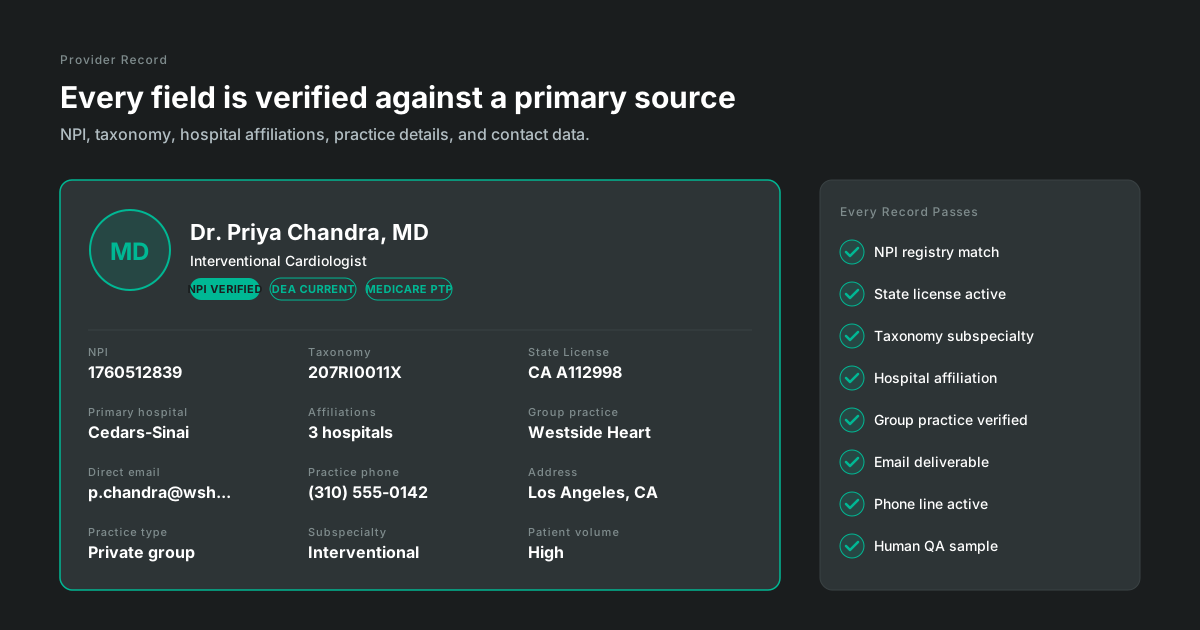
You're selling to healthcare providers. Medical devices, pharma, health IT, services, doesn't matter. Your target market is practices, hospitals, and healthcare organizations.
But generic data validation tools don't understand healthcare. They can't verify an NPI number. They don't know that a practice moved to a hospital system. They can't tell a solo practitioner from a large group practice.
We've built healthcare-specific data capabilities. NPI validation against the NPPES registry. Practice type classification. Specialty-specific rules. Hospital system detection. Validation and enrichment designed around how this market works.
Healthcare-Specific Capabilities
- NPI verification. Each provider record validated against the NPPES National Provider Identifier registry. Deactivated NPIs flagged. Mismatches identified.
- Practice classification. Distinguish solo practices from group practices from hospital-employed physicians. Know who makes the purchasing decision.
- Specialty validation. Confirm specialty matches what providers practice today. Catch outdated or incorrect specialty assignments.
- Hospital system detection. Identify practices that are part of larger health systems. Flag IDN affiliations that affect purchasing.
- New practice detection. Monitor the specialties and geographies in scope for newly opened practices, then route reviewed records to the appropriate team.
- Practice status monitoring. Track closures, mergers, and acquisitions. Know when your targets change.
Specialties We Cover
Orthopedic Surgery
Orthopedic surgeons, sports medicine, joint replacement specialists. High-value device market.
Cardiology
Interventional cardiology, electrophysiology, general cardiology. Complex purchasing dynamics.
Dental
General dentistry, oral surgery, orthodontics, periodontics. Fragmented market, many decision-makers.
Dermatology
Medical dermatology, cosmetic procedures, Mohs surgery. Growing aesthetics market.
Ophthalmology
Cataract surgery, refractive surgery, retina specialists. Equipment-intensive specialty.
Primary Care
Family medicine, internal medicine, pediatrics. Largest market, diverse practice types.
Mental Health
Psychiatry, psychology, counseling practices. Growing market with telehealth expansion.
Physical Therapy
Outpatient PT, sports rehab, specialty physical therapy. Fragmented ownership across the market.
Need a specialty not listed? Contact us →
Why Does Healthcare Provider Data Go Stale So Fast?
Because the ground keeps moving underneath it. Each one of those employment shifts changes a provider's practice name, address, phone tree, and purchasing authority while the NPI stays exactly the same.
Practice M&A compounds it. When a health system or PE platform acquires a group, the providers keep seeing patients at the same address for months while billing, procurement, and decision-making move to a corporate office your list has not heard of. A record can be technically accurate on each field and still route your rep to someone who stopped signing purchase orders a year ago.
Add ordinary churn (retirements, relocations, new graduates opening practices) and healthcare provider files decay faster than standard B2B contact data. A physician list refreshed annually is carrying a meaningful error rate by month six.
How Does NPI Validation Work?
Each US provider who bills electronically holds a National Provider Identifier, and CMS publishes the full NPPES registry as downloadable files updated weekly. That registry is the backbone of our healthcare validation, with three wrinkles worth knowing.
First, NPIs rarely expire and are not reassigned. A provider who retired in 2018 still has an NPI in the file; it just carries a deactivation record you have to check for. Second, the specialty attached to an NPI is a self-reported taxonomy code that providers rarely update, so we confirm specialty against state licensing boards and practice sources instead of trusting the registry alone. Third, the registry address is a billing artifact as often as a practice location. Plenty of NPIs point at a lockbox, a billing service, or a home address.
Our validation pass checks each NPI's existence and status in NPPES, cross-references CMS Doctors and Clinicians data for current affiliations, and verifies the practice location against primary sources. Records that fail come back flagged with the reason, so you know whether you're looking at a retired provider, a moved practice, or a typo.
Who This Is For
Medical device companies who need accurate provider data for their sales territories. Device reps burn expensive field time on bad addresses.
Pharmaceutical companies targeting specific prescribers. A prescriber list with non-prescribers on it wastes samples and rep visits.
Healthcare IT vendors selling EHRs, billing, or practice management tools into practices.
Healthcare services companies who need to identify and reach practice decision-makers.
Healthcare marketing agencies running campaigns where the client sees each bounce.
Healthcare Data Services
our standard services are available with healthcare-specific enhancements:
Data Validation. NPI verification, license status, practice operating status, address validation against practice locations.
Data Enrichment. Specialty classification, practice type, hospital affiliations, bed counts, procedure volumes where available.
Data Discovery. New practice detection, physician movement tracking, market mapping by specialty and geography.
Data Maintenance. Ongoing NPI monitoring, practice status tracking, contact currency verification.
Why Healthcare Companies Choose Us
- ✓ We understand the data. We know what an NPI means, how to validate it, and what happens downstream when it's wrong.
- ✓ We know the market dynamics. Private practice vs. hospital-employed. Solo vs. group. IDN vs. independent. These distinctions decide who signs the purchase order.
- ✓ We have the right data sources. NPPES, state licensing boards, CMS data, specialty-specific registries. Generic business databases carry none of these.
- ✓ Healthcare-specific review. Rules cover provider identity, practice status, specialty, ownership signals, and source conflicts.
How Is a Healthcare Data Project Scoped?
The written quote defines the eligible records, requested registry and practice fields, validation dates, exception rules, review method, delivery format, and schedule. Compare proposals against the same representative sample and acceptance criteria. See the current charge-structure overview.
Retain the source date and field-level provenance with the returned file. Review ambiguous provider identities, affiliations, specialty classifications, and practice ownership signals before using them for routing or outreach.
Common Questions
Do you sell healthcare data lists?
We can build custom prospect lists for healthcare markets, but our primary service is validating and enriching data you already have or acquire elsewhere.
How current is your NPI data?
Each project should identify the NPPES source file or query date used for validation. Confirm the current status in NPPES when the record will drive an operational decision.
Can you identify prescribers vs. non-prescribers?
Yes. We can flag providers by their credential type and whether they have prescribing authority in their state.
Do you cover hospitals and health systems?
Yes. We validate organizational NPIs and can enrich with bed counts, system affiliations, and organizational hierarchies.
Which data sources do you validate against?
NPPES for NPI status, state licensing boards for license verification, CMS Doctors and Clinicians data for affiliations, and specialty registries plus practice websites for confirmation. Sources are cross-checked rather than trusted individually.
Is healthcare provider data covered by HIPAA?
First determine whether the workflow uses protected health information. If it does, document the permitted purpose, minimum necessary fields, access controls, storage, and disclosures against the HHS Privacy Rule materials.
Get Provider Data Your Reps Can Trust
Generic data tools create generic problems in healthcare markets. We structure projects around specialty, credential, practice, and affiliation fields, then return source dates and review notes with the delivery.
Related: NPI Validation | New Practice Detection | All Services