Orthopedic Data Is High-Stakes
You're selling implants, instruments, or services to orthopedic surgeons. A single joint reconstruction account can be worth six figures a year, so each bad record in a territory list is revenue handed to a competitor with cleaner data.
And orthopedic data is notoriously messy. Surgeons move between practices. Hospital employment arrangements change. Subspecialties get misclassified. Your hip surgeon list includes spine surgeons. Your list of private practice surgeons includes hospital employees.
When a field rep shows up to call on a joint replacement surgeon and finds a hand specialist, or worse, someone who left six months ago, that's a wasted day in a territory that can't afford waste.
How Big Is the Orthopedic Surgeon Universe?
That has two consequences for anyone selling into the specialty. Retirements remove surgeons from your addressable market each quarter, usually without any public announcement. And the fellows replacing them enter practice with different subspecialty training, different employer types, and no existing vendor loyalties.
Roughly nine in ten orthopedic surgeons complete fellowship training, so subspecialty is the norm rather than the exception. A list that stops at "orthopedic surgery" describes almost nobody's practice. The census also shows steady movement away from independent private practice toward hospital employment and large group models, which changes who controls purchasing even when the surgeon's name and address stay the same.
What We Validate
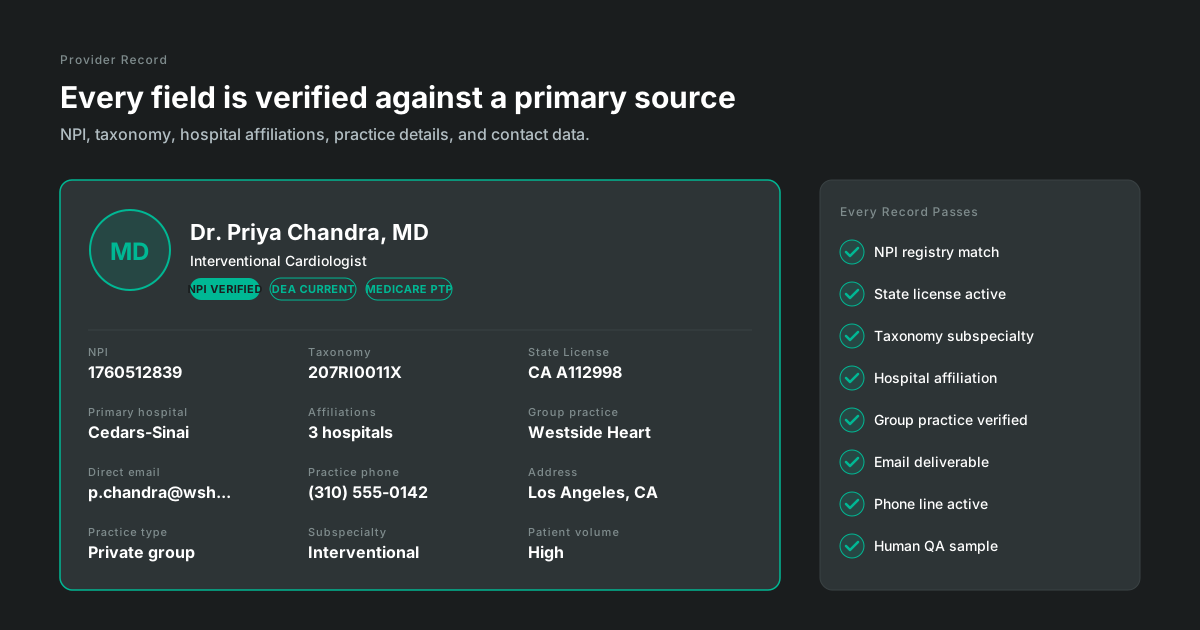
- NPI verification. Each surgeon verified against the NPPES registry. Active license status confirmed.
- Subspecialty classification. Joint replacement, spine, sports medicine, trauma, hand, foot/ankle, pediatric, oncology. Accurate subspecialty assignment.
- Practice type. Private practice, hospital-employed, academic, ambulatory surgery center. Know who makes purchasing decisions.
- Hospital affiliations. Which hospitals they operate at. IDN relationships that affect purchasing.
- Practice location. Current address verified. Multiple locations identified.
- Contact information. Office phone, email where available, practice manager contacts.
Subspecialty Intelligence
Orthopedic surgeons aren't interchangeable. A spine surgeon doesn't buy knee implants. A hand specialist doesn't care about your hip system. Subspecialty correctness is critical for targeting.
We classify orthopedic surgeons into subspecialties based on:
- Fellowship training records
- Procedure volume data where available
- Practice website analysis
- Hospital credentialing information
- Professional society memberships
The result: your total joint list contains total joint surgeons. Your spine list contains spine surgeons. Your targeting works.
Practice Type Determines the Sales Motion
In orthopedics, practice type determines who you sell to:
Private practice: The surgeon (or practice administrator) makes purchasing decisions. Direct sales relationship.
Hospital-employed: Purchasing goes through hospital supply chain. Different sales motion, different contacts.
Academic: Complex purchasing with department heads, hospital administration, and physician preference cards.
ASC-based: Ambulatory surgery center ownership or affiliation changes the economics and decision-makers.
We classify practice type so your sales team knows who they're selling to before they walk in the door.
Why Are Joint Replacements Moving to ASCs?
CMS removed total knee arthroplasty from the Medicare inpatient-only list in 2018 and total hip arthroplasty in 2020. Since then, a growing share of joint replacement volume has shifted from hospital operating rooms to ambulatory surgery centers, where surgeons frequently hold ownership stakes.
For device sellers this rewires the account map. A surgeon who operates at an ASC he part-owns cares about implant spend in a way a hospital-employed surgeon rarely had to, because the savings land in his pocket. Physician preference still drives the choice, but the economics moved from the hospital's supply chain office into the surgeon's partnership meeting.
So we track where surgeons operate, and flag ASC affiliations and ownership stakes where they appear in public records. A territory plan that treats ASC-based joint surgeons like hospital cases will charge and pitch wrong in both directions.
New Practice and Surgeon Detection
New orthopedic practices are prime targets. They're making purchasing decisions, establishing vendor relationships, and haven't been overwhelmed by each other rep yet.
We monitor for:
- New orthopedic practice openings
- Surgeons leaving hospitals to start private practices
- New surgeons completing fellowship and entering practice
- Practice acquisitions and consolidations
Timing is the whole game here. Orthopedic fellowships finish in the summer, so a wave of new subspecialists enters practice each August with preference cards still unwritten. The rep who reaches a new spine surgeon in month two of practice is building a relationship; the rep who arrives in year two is trying to displace one. The same logic applies to acquisitions. When a PE platform or health system absorbs a group, vendor agreements get reviewed, and for a short window the incumbent has no more standing than the challenger.
Detection runs continuously against NPPES additions, state license issuances, practice websites, and hospital credentialing announcements, so new targets show up in your file within weeks of appearing in the market rather than at the next annual list refresh.
What You Get
You receive practice and surgeon records with the requested fields, source notes, and ambiguous affiliations marked for review.
Per surgeon:
- NPI (verified)
- Full name and credentials
- Subspecialty classification
- Practice name and type
- Practice address (verified)
- Office phone
- Email where available
- Hospital affiliations
Per practice:
- Practice name
- Practice type (private, hospital, academic)
- Number of surgeons
- All locations
- Practice administrator contact
- Estimated procedure volume (where available)
Pricing
Orthopedic data services follow our healthcare pricing:
- Validation only: quoted after the submitted fields and checks are reviewed
- Validation + enrichment: quoted after coverage targets and source requirements are defined
- New surgeon detection: quoted for the geography, specialties, and delivery cadence in scope
- Ongoing maintenance: Custom based on list size
Common Questions
Can you identify high-volume surgeons?
In some cases. CMS publishes procedure volume data for Medicare patients. We can enrich with this data where available, though it's not complete.
Do you track ASC ownership?
We can identify surgeons who have ownership stakes in ASCs where this information is publicly available through state licensing or CMS records.
How do you handle surgeons at multiple locations?
We capture practice locations for each surgeon. You can target based on primary location or include locations in territory assignments.
What about physician assistants and nurse practitioners?
We can include orthopedic PAs and NPs if you need them. They have their own NPIs and we validate them the same way.
Can you separate private practice surgeons from hospital-employed ones?
Yes, and for orthopedics it is one of the most requested fields. We classify each surgeon as private practice, hospital-employed, academic, or ASC-based using affiliation data, practice websites, and CMS records, so your reps know which sales motion applies before the first call.
How many orthopedic surgeons are there in the US?
Do not treat orthopedics as one audience. Define the needed subspecialties, roles, locations, affiliations, and source dates, then report the count returned by the approved sources for that exact specification.
Get Orthopedic Data You Can Trust
Your orthopedic territory is too valuable for bad data. We validate and enrich your surgeon lists so your reps spend their time with the right targets.
Related: Cardiology Data | NPI Validation | All Healthcare Specialties