Cardiology Is Complex, Your Data Needs to Reflect That
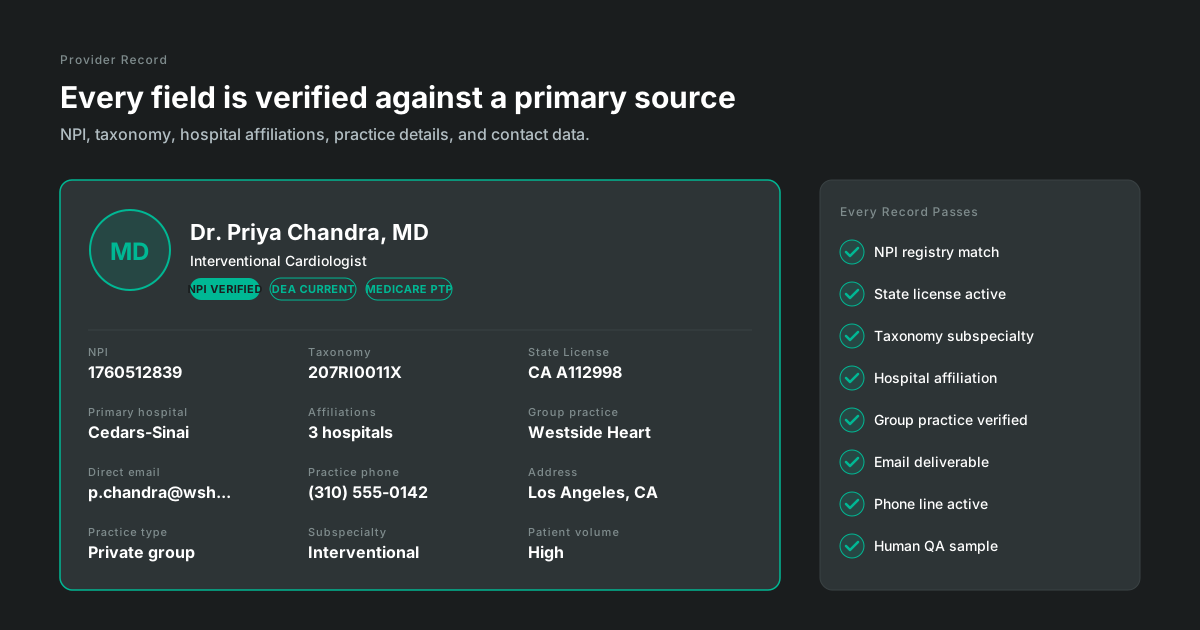
You're selling to cardiologists. Maybe stents, maybe pacemakers, maybe imaging equipment, maybe drugs. But "cardiologist" covers a huge range of specializations with completely different purchasing behaviors.
An interventional cardiologist doing cath lab procedures has nothing in common with a non-invasive cardiologist reading echos. An electrophysiologist implanting devices has different needs than a heart failure specialist managing medications.
Cardiology also has hospital relationships baked into the economics. Most cardiologists are either hospital-employed or dependent on hospital cath lab access, and the affiliation determines who approves a purchase.
Why Is Cardiology the Most Hospital-Employed Specialty?
Two decades ago the typical cardiologist was a partner in an independent group.
For anyone selling into cardiology, that history rewrote the org chart. The physician who wants your device often can't sign for it. The decision runs through the hospital's value analysis committee, supply chain, and service line administrator, with the cardiologist as champion rather than buyer. A territory list that doesn't distinguish employed from independent physicians hides this from your reps until they're three meetings deep.
The counter-trend is newer and smaller: some interventionalists and EPs are moving procedures into physician-owned labs where they control purchasing again. More on that below.
Subspecialty Classification
We classify cardiologists into meaningful subspecialty categories:
- Interventional cardiology. Cath lab procedures, stents, structural heart. High device utilization, hospital-centric.
- Electrophysiology. Arrhythmia treatment, device implantation (pacemakers, ICDs), ablations. Specialized equipment and vendors.
- Heart failure/Transplant. Advanced heart failure management, VADs, transplant. Often academic or major health system based.
- Non-invasive/Imaging. Echo, nuclear cardiology, cardiac CT/MRI. Diagnostic focus, different equipment needs.
- General cardiology. Outpatient cardiology, medical management. Less procedural, different vendor relationships.
- Pediatric cardiology. Congenital heart disease. Separate market with different dynamics.
The NPI registry helps here, but only partially. NUCC taxonomy codes exist for the major subspecialties: 207RC0000X for cardiovascular disease, 207RI0011X for interventional cardiology, 207RC0001X for clinical cardiac electrophysiology, 207RA0001X for advanced heart failure and transplant cardiology, and 2080P0202X for pediatric cardiology. The catch is that physicians pick their own codes at enrollment and rarely update them. An interventionalist who registered under the general cardiovascular disease code in 2009 still looks like a general cardiologist in NPPES today. We use taxonomy as a starting signal, then confirm against fellowship history, procedure patterns, and how the physician describes their own practice.
Cath Labs Are Leaving the Hospital
The biggest structural change in cardiology delivery is where procedures happen. CMS added diagnostic catheterization to the ASC covered-procedures list in 2019 and percutaneous coronary intervention in 2020, which made physician-owned settings financially viable for work that used to require a hospital. Office-based labs (OBLs) grew alongside, especially for peripheral vascular procedures.
Each site of service is a different sales conversation:
| Site of service | Who controls purchasing | What that means for targeting |
|---|---|---|
| Hospital cath lab | Value analysis committee, supply chain | Long cycle. Physician is champion, administrator signs. |
| ASC | Physician owners plus management company | Faster decisions, sharper charge sensitivity. |
| Office-based lab | The physician, directly | Shortest path to a decision-maker in cardiology. |
A cardiologist operating in an OBL two days a week is a better prospect for some products than the same subspecialist working only hospital cases. Generic provider lists don't carry this field in practice. We flag ASC and OBL activity wherever it can be verified.
Hospital Affiliation Intelligence
In cardiology, hospital relationships determine everything. Interventional cardiologists need cath lab access. EPs need device implant suites. Even general cardiologists have hospital rounding privileges.
We track:
- Primary hospital affiliation
- Additional hospital privileges
- Hospital employment vs. independent practice
- Cath lab director roles
- Department head positions
Mapping these relationships shows you where physician preference ends and hospital purchasing begins for each account.
Four Practice Settings, Four Buying Processes
Hospital-employed: Purchasing decisions involve hospital administration, supply chain, and value analysis committees. Physician input but corporate process.
Private practice with hospital privileges: More physician control, but still subject to hospital relationships for procedures. Dual influence on purchasing.
Large cardiology groups: May have their own cath labs, imaging centers, and centralized purchasing. Group leadership drives decisions.
Academic: Research interests, training programs, and institutional politics affect purchasing. Longer sales cycles, different value propositions.
What We Validate and Enrich
- NPI verification. Each cardiologist verified against the NPPES registry. Active license status confirmed.
- Subspecialty classification. Interventional, EP, heart failure, general, accurate subspecialty assignment based on fellowship, procedure volume, and practice focus.
- Hospital affiliations. hospital relationships identified with primary vs. secondary designation.
- Practice type. Hospital-employed, private practice, academic, large group.
- Procedural volume. Where available from CMS or other sources, procedure counts by type.
- Contact information. Office locations, phone, email where available.
What You Get
You receive practice and clinician records with the requested fields, source notes, and uncertain affiliations marked for review.
Per cardiologist:
- NPI (verified)
- Full name and credentials
- Subspecialty classification
- Practice name and type
- Practice address (verified)
- Office phone
- Hospital affiliations (all)
- Leadership roles (if any)
Per practice/hospital:
- Organization name
- Type (private group, hospital, academic)
- Number of cardiologists by subspecialty
- Cath lab presence (Y/N)
- EP lab presence (Y/N)
- Key administrative contacts
Pricing
Cardiology data services follow our healthcare pricing:
- Validation only: Quote eligible cardiologists and checks in writing
- Validation plus enrichment: Quote requested fields, sources, and review rules
- Hospital affiliation mapping: Included with enrichment
- Procedure-volume append: Separate the data source, measurement period, and matching method
Common Questions
How accurate is subspecialty classification?
Subspecialty results depend on the evidence available for each physician. Return the source, source date, confidence, and unresolved conflicts; flag ambiguous mixed-practice cases instead of forcing a classification.
Can you identify high-volume implanters?
For device implanters, we can append CMS procedure volume data. It covers Medicare patients only, but Medicare is the dominant payer for pacemakers and ICDs, so the counts are a workable proxy for total implant volume.
Can you tell hospital-employed cardiologists from independent ones?
Yes. Employment status shows up in the organizational NPI a cardiologist bills under, group practice listings, and hospital directories. We classify each record as hospital-employed, independent with privileges, large group, or academic, because each of those means a different buying process.
Do you cover office-based labs and ASCs?
Yes. We flag cardiologists operating in office-based labs and ambulatory surgery centers, and identify the facility where we can verify it. These sites have physician owners making their own purchasing decisions, which makes them a different call than a hospital cath lab.
Do you track which hospitals use which vendors?
Complete vendor penetration data is unavailable. We can sometimes identify installed vendors from job postings, case studies, and public information. Treat that as directional input rather than a verified field.
What about cardiac surgeons?
CT surgeons are a separate specialty with their own taxonomy codes. We can include them if you need a complete structural heart or cardiac surgery target list, since TAVR and mitral programs involve both specialties.
Target the Right Cardiologists
Cardiology targeting fails when subspecialty and hospital relationships aren't understood. We validate and classify your data so your reps call the right cardiologists with the right message.
Related: Orthopedic Data | NPI Validation | All Healthcare Specialties