Primary Care Is Huge and Highly Varied
There are over 200,000 primary care physicians in the US. It's the largest single market in healthcare. But "primary care" covers enormous variation: solo family docs in rural areas, hospital-employed internal medicine physicians in urban systems, concierge practices, FQHCs, urgent care, retail clinics.
Each practice type has different purchasing authority, different decision-makers, and different needs. A one-size-fits-approach to primary care doesn't work.
We classify primary care practices by type and structure so you can target appropriately.
Where Have the Independent Practices Gone?
Employment status is the first filter to apply to any primary care list, because it decides whether the physician in your row can buy anything in practice. And the ground has shifted. Hospitals, health systems, payers, and PE-backed groups employ the rest.
The shift isn't evenly distributed. Internal medicine physicians skew more heavily toward hospital employment than family physicians, and younger physicians overwhelmingly choose employment over ownership. Meanwhile family medicine remains the backbone of ambulatory care. The American Academy of Family Physicians points out that family physicians handle more office visits than any other physician specialty.
A raw list of primary-care physicians does not establish local purchasing authority. Classify practice ownership and decision structure separately, then route records to a practice-level or system-level motion from that evidence.
Specialty Classification
We classify primary care physicians by specialty:
- Family medicine. ages, broadest scope. Largest segment of primary care.
- Internal medicine. Adult focus. Higher proportion hospital-employed than family medicine.
- Pediatrics. Children only. Different patient mix, different product needs.
- Geriatrics. Elderly focus. Growing segment with specific needs.
- Med-Peds. Combined internal medicine/pediatrics training. Treats ages.
Practice Type Classification
Practice type determines who makes purchasing decisions:
Independent/Private practice: Physician-owned practices make their own purchasing decisions. Practice administrator or physician handles vendor relationships.
Hospital-employed: Purchasing goes through hospital supply chain. Physicians have limited direct purchasing authority.
Large physician groups: Multi-site groups often have centralized purchasing, operations teams, and corporate decision-makers.
FQHC (Federally Qualified Health Centers): Community health centers with unique funding, purchasing requirements, and administrative structures.
Urgent care: Walk-in focused, often corporate-owned chains. Centralized purchasing common.
Retail clinic: CVS MinuteClinic, Walgreens, etc. Corporate purchasing, standardized protocols.
Concierge/DPC: Direct primary care practices with different economics and often different product preferences.
Why Taxonomy Codes Overstate Primary Care
NPPES taxonomy codes are useful inputs for a primary-care universe. Preserve the code and source date from the NPI Registry, and define which family-medicine, internal-medicine, and pediatrics records belong in the project.
Taxonomy alone is not a final classification. Compare it with current practice pages, board or directory sources, and other approved evidence, then route conflicts to review. This prevents an old or broad taxonomy value from silently determining the sales segment.
Site-of-care codes cut the other way. We build the universe from both entity types, then use practice websites, health system rosters, and claims-adjacent signals to strip out hospitalists and mislabeled subspecialists before you ever see the file.
What We Validate and Enrich
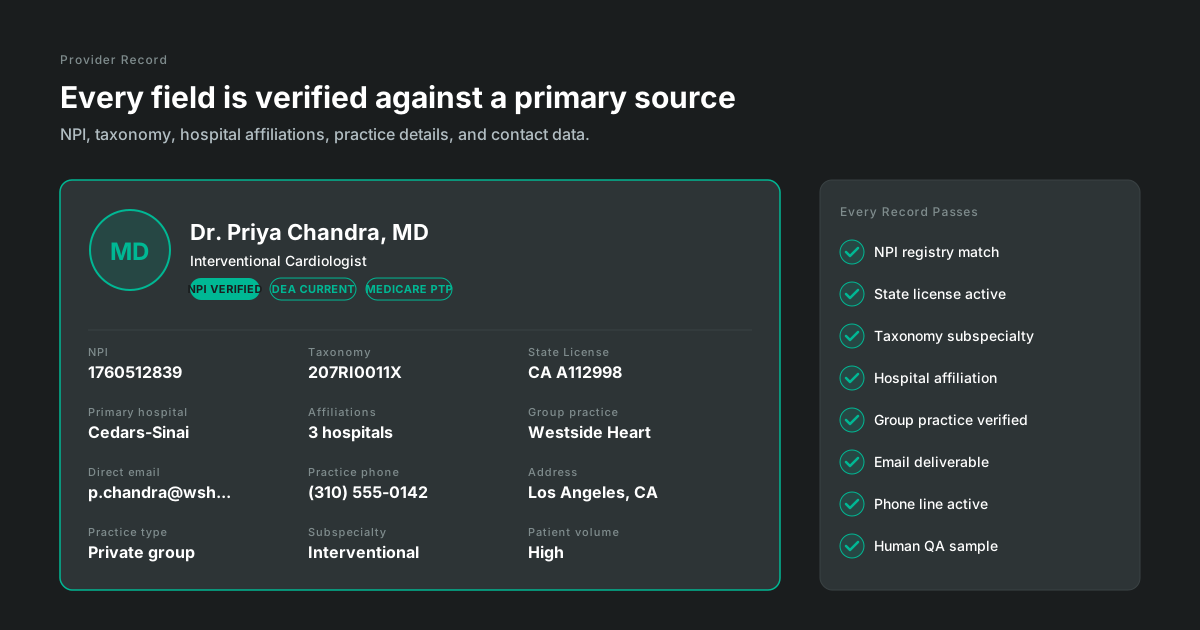
- NPI verification. Each physician verified against the NPPES registry.
- Specialty classification. Family medicine, internal medicine, pediatrics, etc.
- Practice type. Independent, hospital-employed, group, FQHC, urgent care, etc.
- Practice size. Number of providers, estimated patient panel size where available.
- Location verification. Current practice address, multiple location flagging.
- Decision-maker identification. Physician-owner, practice administrator, office manager.
Health System Affiliation Tracking
Primary care has rapidly consolidated into health systems. Understanding these affiliations is critical:
- Health system ownership vs. affiliation
- ACO participation
- Clinically integrated network membership
- EHR platform (often system-wide)
We track major health system affiliations to help you understand which practices buy independently vs. through system agreements.
Affiliation is messier than ownership. A practice can be physician-owned yet locked into a system's clinically integrated network, running the system's Epic instance and bound by its formulary and vendor agreements. On paper that's an independent practice. In a sales conversation it behaves like an employed one. That's why we record affiliation and ownership as separate fields rather than collapsing them into one label, and why the EHR field is worth checking: a small practice running a health system's EHR usually signals a tighter relationship than its ownership status suggests.
What You Get
You receive practice and clinician records with the requested fields, source notes, and unresolved conflicts identified for review.
Per physician:
- NPI (verified)
- Full name and credentials
- Specialty
- Practice name
- Practice address (verified)
- Office phone
- Health system affiliation (if any)
Per practice:
- Practice name
- Practice type
- Number of providers
- All locations
- System/group affiliation
- Decision-maker contacts
Pricing
Primary care data services follow our healthcare pricing:
- Validation only: Quote eligible physicians and checks in writing
- Validation plus enrichment: Quote requested fields, sources, and review rules
- Practice type classification: Included with enrichment
- New-practice detection: Define geography, qualifying event, evidence, and cadence
Volume discounts available for large lists.
How to review a primary-care delivery
Review clinicians and practice organizations separately, then check current location and affiliation evidence for each sampled record. Flag shared addresses, hospital-owned practices, and ambiguous specialties for manual review because those cases affect routing differently. Preserve the source date and proposed disposition beside the record so the team can approve changes and reproduce the decision during the next refresh.
Common Questions
How do you identify independent vs. hospital-employed?
Multiple signals: practice name patterns, NPI organization type, address matching to hospital systems, and manual verification for ambiguous cases.
Can you identify which EHR a practice uses?
We can often identify EHR platforms, especially for practices on major systems (Epic, Athenahealth, eClinicalWorks). Coverage varies by practice type.
Do you include nurse practitioners and PAs?
We can. Primary care increasingly relies on NPs and PAs, especially in FQHCs and urgent care. Let us know if you want them included.
What about practices that are both primary care and urgent care?
Common in retail and some group settings. We classify based on primary focus but flag hybrid models.
Can you separate concierge and direct primary care practices?
Yes. DPC and concierge practices advertise their model, so membership pricing pages, cash-pay language, and the absence of insurance participation make them identifiable. They're worth separating because they buy like small businesses, without payer-driven constraints.
How do you keep hospitalists out of a primary care list?
Taxonomy alone can't do it, since most hospitalists carry the internal medicine code. We check practice addresses against hospital campuses, look for outpatient scheduling presence, and flag physicians with no ambulatory footprint so you can exclude them.
Make Sense of Primary Care
Primary care is too large and varied for generic lists. We classify practices by type and structure so you can target the right physicians with the right approach.
Each returned classification should include its source and review date so a reviewer can trace the value, resolve conflicts, and repeat the same check later.
Related: Mental Health Data | New Practice Detection | All Healthcare Specialties