The Dental Market Is Fragmenting and Consolidating Simultaneously
Dental is weird. But it's also rapidly consolidating as DSOs (dental service organizations) acquire independent practices.
This creates data chaos. That independent practice you targeted last month? Now it's a DSO location with centralized purchasing. That general dentist on your list? Retired and sold to a young associate you don't have in your database.
Dental data changes fast. If you're not validating and updating regularly, you're working a list that's increasingly disconnected from reality.
How Big Is the US Dental Market?
Build the current dentist and practice-location cohort from dated professional and government sources. Keep individual providers, practice locations, billing organizations, and parent groups as separate entities so the count is reproducible.
Ownership structure changes over time, so record the source date and definition used for solo practices, groups, and dental service organizations. A historical national trend should not be treated as the current structure of a local territory.
For anyone selling into dental, those two curves matter more than the headline practice count. The independent solo practice that dominated your addressable market in 2010 is a shrinking segment. The multi-location group with centralized purchasing is the growing one. A list that doesn't distinguish between them treats two different buying processes as one.
Why Does Dental Practice Data Decay So Fast?
Ownership turnover. Dental practices change hands more often than most healthcare segments because the exit path is well established: retiring dentists sell to associates, private buyers, or DSOs, and DSO acquisition teams are actively hunting for targets. Each sale can change the practice name, the decision-maker, the purchasing process, and sometimes the address.
Add the ordinary churn on top of that. Office managers move between practices. Associates leave to start their own offices. Practices open second locations under new registered entities. A dental list that was accurate in January has drifted noticeably by summer.
This is standard CRM hygiene math applied to a market that moves faster than average. Measure change against a dated baseline instead of applying a general decay benchmark, then set the review cadence from the changes observed in your own system. Dental runs hotter because of the acquisition activity. If your team last validated its practice list more than six months ago, assume a meaningful slice of it points at owners who no longer own, addresses that no longer exist, and independents that now buy through a DSO procurement desk.
The fix is periodic validation against primary sources, the NPPES registry, state licensing boards, and the practices themselves. That's the work we do. If you want the background on what enrichment adds beyond validation, our data enrichment guide covers the difference.
What We Validate and Enrich
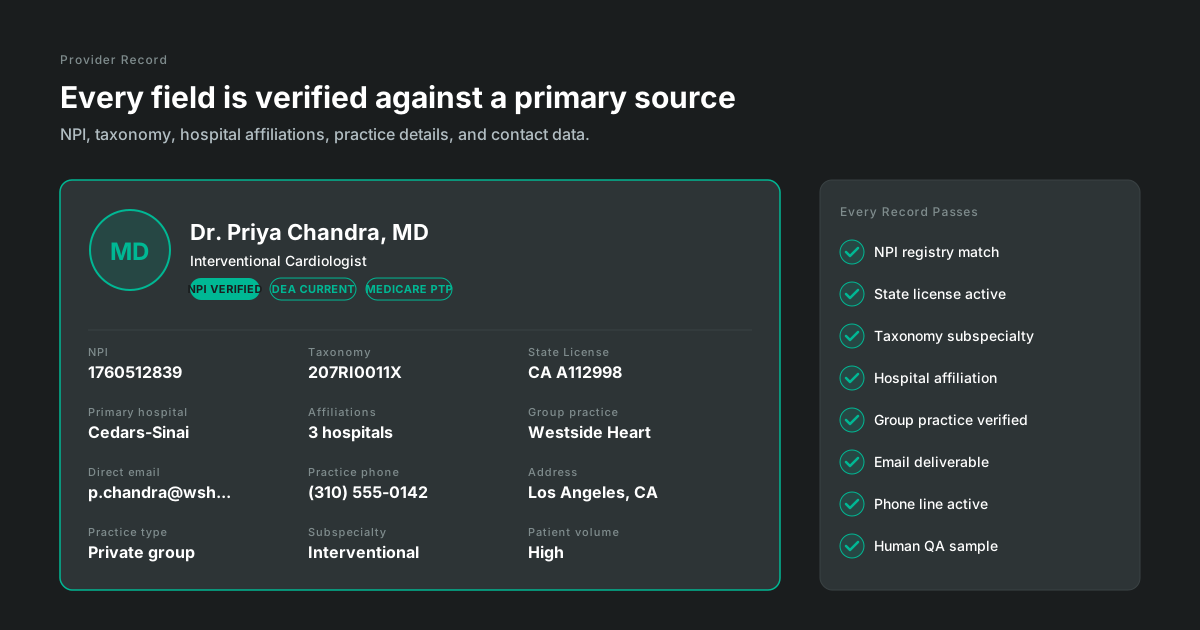
- NPI verification. Each dentist verified against the NPPES registry. License status confirmed.
- Specialty classification. General dentistry, orthodontics, oral surgery, periodontics, endodontics, pediatric dentistry, prosthodontics. Accurate specialty assignment.
- DSO affiliation. Identify practices affiliated with dental service organizations. Know which locations buy through corporate vs. independently.
- Practice type. Solo practice, group practice, DSO-owned, academic, community health center.
- Decision-maker identification. Dentist-owner, practice manager, office manager, corporate contact for DSO locations.
- Practice location. Current address verified. Multiple location practices identified.
DSO Intelligence
DSOs have rewired dental purchasing. When a practice joins a DSO, purchasing often shifts to corporate. Your sales motion changes completely.
We track DSO affiliations for major groups including:
- Heartland Dental
- Aspen Dental
- Pacific Dental Services
- Dental Care Alliance
- Affordable Care
- Regional and emerging DSOs identified from dated ownership sources
For each DSO-affiliated practice, we identify whether purchasing is centralized, partially centralized, or still practice-controlled.
Specialty Matters in Dental
Different dental specialties have different needs:
General dentistry: Broadest market, most fragmented, mix of independent and DSO.
Orthodontics: Specialty practices and general dentists offering ortho. Invisalign vs. traditional brackets.
Oral surgery: Often hospital-affiliated. Implants, extractions, complex procedures.
Periodontics: Gum disease specialists. Implant placement, surgical procedures.
Endodontics: Root canal specialists. High-volume, specialized equipment.
Pediatric dentistry: Different patient mix, different equipment needs, often DSO-affiliated.
Who Makes Purchasing Decisions at a Dental Practice?
Depends entirely on the practice type, which is why classification comes before outreach.
At a solo or small group practice, the dentist-owner signs off on anything meaningful and the office manager controls the day-to-day supply ordering. Sell equipment, and you need the owner. Sell consumables, and the office manager is often the real account. Plenty of reps burn weeks pitching a dentist who delegated supply decisions years ago.
At a DSO location, the practice-level staff may have no purchasing authority in practice. Equipment standards, supply agreements, and technology decisions sit with regional or corporate procurement. The right contact might work three states away from the location on your list. Calling the front desk gets you nowhere except a polite referral to a corporate switchboard.
Our decision-maker identification maps each practice to its real buying structure: owner name and contact for independents, the corporate procurement path for DSO locations, and the office manager where that's who orders. One field on a spreadsheet, but it changes which pitch a rep opens with.
New Practice Detection
New dental practices are excellent prospects. They're setting up operatories, choosing suppliers, establishing vendor relationships.
We monitor for:
- New dental practice openings
- Dentists acquiring existing practices
- New graduates entering practice
- Practice expansions (new locations)
- DSO acquisitions (know when an independent goes corporate)
What You Get
You receive practice and decision-maker records with the requested fields, source notes, and review flags attached.
Per dentist:
- NPI (verified)
- Full name and credentials
- Specialty
- Practice name
- Practice address (verified)
- Office phone
- Email where available
Per practice:
- Practice name
- Practice type (solo, group, DSO)
- DSO affiliation (if any)
- Number of dentists
- Number of operatories (where available)
- Decision-maker contacts
- All locations
Pricing
Dental data services follow our healthcare pricing:
- Validation only: Quote the eligible locations and checks in writing
- Validation plus enrichment: Quote requested fields, sources, and review rules
- New-practice detection: Define geography, qualifying event, evidence, and delivery cadence
- DSO affiliation tracking: Included with enrichment
Common Questions
How do you track DSO affiliations?
Multiple sources: DSO corporate websites, state licensing records, practice name patterns, and our proprietary monitoring. DSO landscape changes fast; we update continuously.
How many dental practices are there in the United States?
Build the requested dentist and practice count from dated professional, licensing, and location sources. Separate people from practice locations, record ownership evidence, and report unresolved affiliations instead of applying a national estimate to a local market.
How do you verify a dentist's NPI?
We check each record against the NPPES registry, which CMS updates weekly. That confirms the NPI is active, matches the dentist's name, and carries a dental taxonomy code. We also cross-reference state licensing boards to confirm the license behind the NPI is current. Our data validation service runs the same checks on any provider list.
Can you tell me how many operatories a practice has?
Sometimes. Operatories are not reported in a universal source. We can estimate from dentist count and practice type, or use a figure the practice publishes.
Do you cover dental hygienists?
We focus on dentists and practices. Hygienists typically don't have purchasing authority, so they're not usually useful for sales targeting.
What about dental labs?
Dental labs are a different market. We can help if you need lab data, but it requires different data sources than practice data.
Target the Right Dental Practices
The dental market is too fragmented for bad data. We validate and enrich your lists so you know who's independent, who's DSO, and who makes purchasing decisions.
Related: Primary Care Data | New Practice Detection | All Healthcare Specialties