Role-specific data support
Sales Operations
Territory data, lead routing, duplicate management, and CRM hygiene. Keep your sales engine running clean.
Marketing Operations
Email deliverability, lead scoring data, campaign targeting, and marketing contact management.
Revenue Operations
Cross-functional data quality, unified customer records, and the data foundation for your revenue engine.
Sales Leaders
Your team wastes hours on bad data. Here's how to fix it and get them back to selling.
Data Teams
You know your data needs work. We can be your execution arm for validation, enrichment, and maintenance.
What Role Are You Solving For?
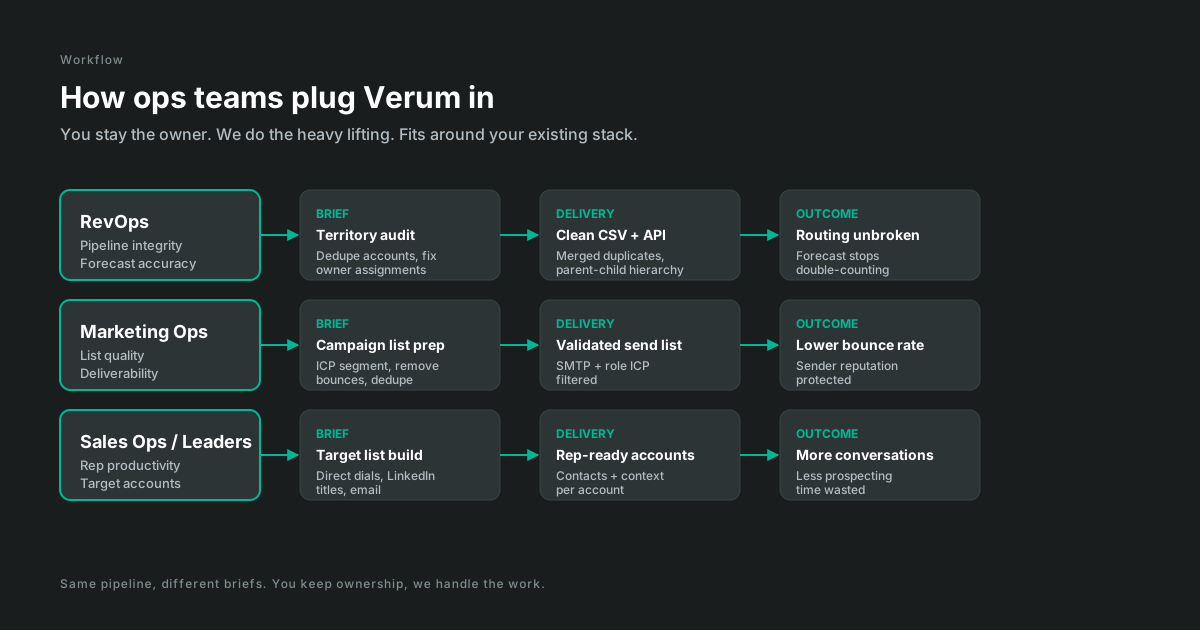
Data quality problems look different depending on where you sit:
- Sales Ops sees bad data through lead routing failures, territory misalignment, and duplicate accounts wasting rep time.
- Marketing Ops sees it through bounce rates, deliverability problems, and campaigns hitting the wrong contacts.
- Revenue Ops sees the full picture, and the challenge of maintaining quality across the entire funnel.
- Sales Leaders see their teams frustrated, wasting time on data tasks instead of selling.
- Data Teams see the technical debt and know what needs to happen, but need execution capacity.
We've built solutions for each perspective. Find yours above.
Why Organize by Role Instead of Industry?
Same duplicate accounts, same stale contacts, same missing fields. They just experience the damage in different places, and they buy fixes with different budgets.
Our industry pages answer a different question: what does clean data look like for a healthcare company versus a SaaS company versus a manufacturer. Those pages are about the data itself. These role pages are about the job you're trying to do with it. If you're a Marketing Ops manager at a fintech, read both the Marketing Ops page and the fintech page. The overlap is the project.
What Does a First Project Look Like for Each Role?
Most engagements start small: one file, one painful problem, one deliverable you can judge in a spreadsheet. Here's what that first project typically looks like by role.
| Role | Common first project | What comes back |
|---|---|---|
| Sales Ops | CRM deduplication and territory field cleanup | Merged accounts, standardized fields, routing that stops misfiring |
| Marketing Ops | Email validation before a major send | Validated list with bounce-risk and domain-wide acceptance flags on each record |
| Revenue Ops | Full-funnel data quality audit | Field-level completeness report plus a prioritized fix plan |
| Sales Leaders | Target account list verification | Confirmed-operating businesses with the right contact at each one |
| Data Teams | Enrichment backlog execution | Appended firmographic and contact fields from the sources selected for the project |
Verum provides a written, scope-specific charge and schedule after reviewing the records, requested checks, exception rules, and delivery format.
Which Services Do These Roles Buy Most?
Three services account for most of the work across all five roles. Cleaning is the usual entry point, especially CRM hygiene projects where duplicates and dead records have piled up for years. Enrichment comes next, filling in the industry, employee count, and contact fields your reps otherwise research by hand. Validation rounds it out, verifying emails and phone numbers work before a campaign or call block depends on them.
Sales Ops and Marketing Ops tend to buy these as separate projects tied to a specific fire. Measure change against a dated baseline instead of applying a general decay benchmark, then set the review cadence from the changes observed in your own system.
How Should Teams Share Ownership?
Start with one accountable owner and a written handoff between teams. Sales Ops can define account and territory rules, Marketing Ops can set deliverability and consent requirements, and Data Teams can specify formats, identifiers, and import controls. RevOps usually coordinates those decisions when the role exists.
The owner does not need to perform each cleanup task. The job is to decide which system is authoritative, approve merge rules, and resolve the small group of records that remain ambiguous after automated checks. Without that decision point, each team fixes its own copy of the data and the systems drift apart again.
A useful brief names the business event that triggered the work. A campaign launch, territory change, CRM migration, or board reporting cycle gives the project a deadline and a clear test. It also keeps the scope tied to a result. “Fix the database” is too broad. “Prepare the target-account file for routing and outreach” tells everyone which fields matter and which records can wait.
After delivery, assign each recurring check to the team closest to the failure. Marketing Ops should watch hard bounces and consent flags. Sales Ops should monitor duplicate creation and routing exceptions. Data Teams should watch failed imports and broken identifiers. The shared scorecard can stay small as long as each metric has an owner and a response.
Document the owner, review cadence, and escalation path next to each rule. New team members can then understand why the rule exists, what evidence it uses, and where an exception belongs.
Keep a dated copy of the source export and the approved rule set with each delivery. When a routing, suppression, or ownership decision is disputed later, the team can trace it to the record and reviewer instead of reconstructing the project from memory.
Record unresolved exceptions and owners too.
Common Questions
Which role page should I read first?
The one that matches your title. Each page covers the data problems that show up in that seat: routing and territories for Sales Ops, deliverability and scoring for Marketing Ops, funnel-wide quality for RevOps, team productivity for Sales Leaders, and execution capacity for Data Teams.
What if my role spans multiple categories?
That's common. Revenue Ops often covers both Sales Ops and Marketing Ops concerns, so check the RevOps page first, then pull from the others for anything specific like email validation or territory cleanup.
Do you work with different roles at the same company?
Yes. We usually start with one function, often Sales Ops or Marketing Ops, and expand once other teams see the cleaned data. Coordinating across functions from the beginning avoids paying to fix the same records twice.
What if I don't see my role listed?
Contact us. We've worked with Customer Success, IT, and Finance teams too. These five pages cover the most common buyers, but the underlying services apply to any team that depends on accurate company and contact records.
Who usually owns data quality, Sales Ops or RevOps?
Before a company has a RevOps function, Sales Ops tends to own CRM data and Marketing Ops owns the email database. Once RevOps exists, cross-functional data quality usually consolidates there. In practice, whoever feels the pain first brings us in.
Does my role change what Verum delivers?
The core services stay the same: cleaning, enrichment, validation, and analysis. What changes is the shape of the first project and the metrics we report against. Marketing Ops cares about bounce rates, Sales Ops cares about routing correctness, and RevOps wants both.
Related: Sales Operations | Revenue Operations | Marketing Operations | pricing