RevOps Has the Hardest Data Job
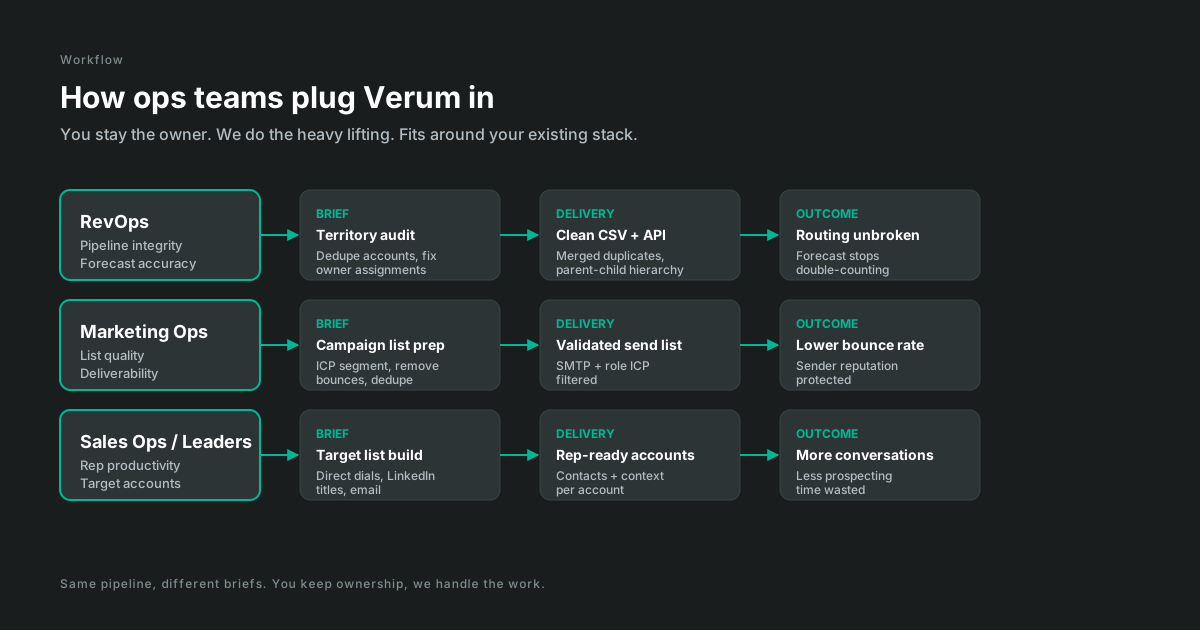
Sales Ops and Marketing Ops may own different systems, while RevOps has to reconcile the records and definitions that cross both.
The same customer appears differently in marketing, sales, and customer success systems. Duplicates split the customer journey. Attribution doesn't work because the data doesn't connect. What the org chart calls a single source of truth is three conflicting sources of confusion.
RevOps needs unified data that tells one consistent story from first touch to continuation. Clean marketing data and clean sales data that disagree with each other still leave you reconciling spreadsheets the night before the board meeting.
Where Do Cross-System Conflicts Come From?
Applications in a multi-system stack may use different units of record, and the seams between them are common sources of RevOps conflicts:
| System seam | Typical conflict | How it shows up |
|---|---|---|
| Marketing automation to CRM | Leads sync without account matching, so the same person exists as a lead and a contact | MQL counts inflate, routing sends known customers to SDRs |
| CRM to customer success platform | CS creates its own account objects keyed on different IDs | Account-extension owner cannot see the original opportunity history |
| CRM to billing/finance | Account names and hierarchies diverge from invoiced entities | Bookings, ARR, and finance revenue reports rarely reconcile |
| Product data to CRM | Usage events keyed on email or workspace, front office keyed on account | PQL scoring misses accounts, expansion signals go unrouted |
None of these is a tooling failure. Each system is doing exactly what it was configured to do. The unification work lives between the systems, which is why it lands on RevOps and why no single platform admin can fix it alone.
RevOps Data Problems We Solve
- Fragmented customer records. Same customer exists differently across systems. We unify records into a single source of truth.
- Cross-system duplicates. Duplicates within systems and across systems. We identify and resolve them with proper merge logic.
- Broken attribution. Can't attribute revenue to marketing because data doesn't connect from lead to opportunity. We fix the linkages.
- Missing lifecycle data. Gaps in the customer journey because data fields aren't populated or standardized. We fill and standardize.
- Reporting inconsistency. Marketing reports one number, sales reports another, finance reports a third. We normalize the data so reports align.
- Data governance gaps. No consistent rules for how data enters and flows through systems. We help establish and enforce standards.
What We Do for RevOps
Data unification. Reconcile records across marketing automation, CRM, and customer success platforms into a reviewed customer profile with retained source identifiers.
Cross-system deduplication. Find duplicates that exist within and across systems. Proper merge logic that preserves history from sources.
Lifecycle data completion. Fill gaps in the customer journey, missing touchpoints, incomplete records, unstandardized fields. The full picture.
Attribution data fix. Ensure marketing touches connect to leads, leads connect to opportunities, opportunities connect to revenue. Attribution that works.
Master data management. Establish golden records for accounts and contacts. Consistent data across systems.
Ongoing data governance. Help establish rules and processes for maintaining data quality across functions, so the cleanup you paid for holds.
The RevOps Value
The payoff shows up in the meetings you stop having. When the pipeline number in the marketing deck matches the one in the sales forecast, the Monday revenue call spends its hour on strategy instead of arguing about whose export is right. Unified data means:
- One source of truth. Marketing, sales, and CS working from the same customer data. No more "which number is right" debates.
- Working attribution. Revenue connects to marketing investment because the lead-to-opportunity linkage holds.
- Complete customer view. See the full journey from first touch through continuation. No gaps, no duplicates, no confusion.
- Aligned teams. When everyone trusts the data, alignment becomes possible. Shared metrics, shared understanding.
- Scalable operations. Automation and AI work when data is consistent. Bad data breaks each tool you add.
Common RevOps Projects
Most engagements start smaller than the full vision. A team comes in for one painful symptom, attribution that won't reconcile or a duplicate-riddled migration, and expands from there once the first project proves out. Sequencing matters: unify accounts before contacts, contacts before activity history, and leave attribution modeling until the underlying linkages hold.
Data unification: The written scope sets the schedule after reviewing source systems, identifiers, field conflicts, hierarchy rules, approval steps, and delivery requirements.
Full-funnel cleanup: Full data quality across marketing, sales, and CS systems. Pre-work for new RevOps platforms or major initiatives.
Attribution data fix: Focused on connecting marketing touchpoints to pipeline and revenue. Compare attribution before and after identity resolution using the same model and reporting window.
Master data implementation: Establish golden records and ongoing governance. Foundation for long-term data quality, and the project that finally makes board reporting a query instead of a week of spreadsheet archaeology.
Pricing for RevOps
RevOps projects tend to be more complete. Typical ranges:
- Data unification: Scope by systems, objects, identifiers, and conflict rules
- Full-funnel cleanup: Scope by stages, source systems, and exception volume
- Attribution repair: Scope by touchpoint sources, identity rules, and the reporting model
- Ongoing governance: Scope by monitored fields, cadence, owners, and escalation rules
Common Questions From RevOps Teams
How do you unify records across multiple systems?
We use fuzzy matching across key fields, email, company name, domain, with confidence scoring. Merge logic preserves history from sources while creating a single golden record.
How long does data unification take?
Includes mapping, matching, merge logic development, and QA.
Can you fix attribution without a full data unification project?
Yes. Attribution-focused projects connect marketing touchpoints to pipeline and revenue. Validate any change by holding the attribution model and reporting window constant before and after identity resolution.
Do you help establish ongoing data governance?
Yes. Beyond cleanup, we help establish rules and processes for maintaining quality across functions. Prevention is better than repeated cleanup.
Should we clean data before or after buying a RevOps platform?
Before. A CDP, MDM tool, or revenue intelligence platform inherits whatever matching mess you feed it, and vendors quote implementation timelines that assume clean inputs. Teams that unify first tend to cut platform implementation time and avoid paying platform-tier prices for basic dedupe work.
We have one RevOps person and no data engineers. Is this still workable?
That's our most common client profile. You define what correct looks like and make the judgment calls; we do the matching, merging, and QA. Your involvement is usually a few hours a week during the project, mostly reviewing edge cases.
Build a Real Single Source of Truth
RevOps can't function without unified data. We help you build the foundation, clean, connected, consistent data that everyone can trust. And unlike a platform purchase, the output lives in your systems: golden records, merge logic, and governance rules that stay yours after the engagement ends.
Related: Sales Operations | Marketing Operations | Data Maintenance