You Know What Needs to Happen
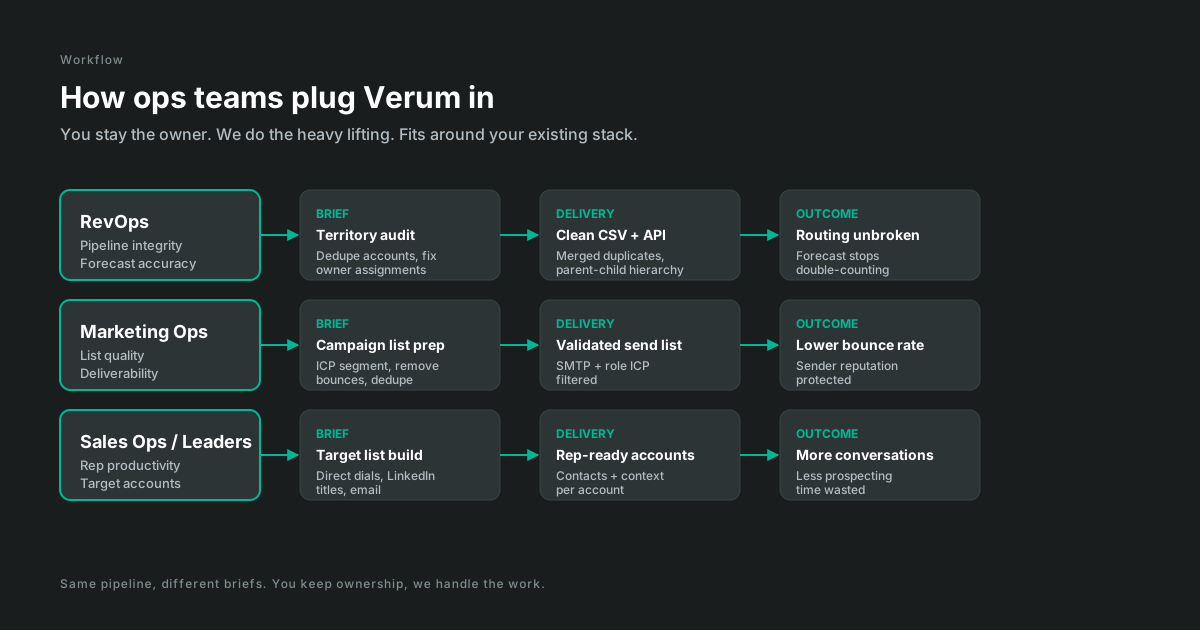
You've identified the data quality issues. You know what validation rules should exist, what enrichment would help, how maintenance should work. Knowing the answer was the easy part. The blocker is execution.
Your team has competing priorities. Building new pipelines, supporting analytics requests, maintaining existing systems, and now each quality ticket competes with an AI initiative for sprint capacity. The record-level work loses that fight each time, and the backlog grows.
We can be the execution capacity you need. You define the specifications. We execute at scale, document what changed, and hand it back.
Why Outsource Work You Already Know How to Do?
Because the constraint is hours, and this particular category of hours is expensive to spend internally. Dedupe review, registry lookups, enrichment waterfalls, title normalization. It's judgment-heavy volume work: too ambiguous to fully automate, too repetitive to justify an engineer's time.
Take one concrete case. Standardizing job titles across a few hundred thousand contact records sounds like a mapping table until you hit "VP Marketing & Chief Evangelist" and have to decide which seniority wins. We wrote up the general approach in our Salesforce job title standardization guide. That decision repeats a thousand times per project with a thousand small variations, and someone has to make each call consistently. Your engineers can. It's just the worst possible use of them.
The build-vs-buy math starts with capacity. Internal execution consumes engineer time and delays the product work they were hired to build. Verum provides a written, scope-specific quote after reviewing the records, requested checks, exception rules, and delivery format. When the task is applying known rules to a large file, compare that quote with the fully loaded internal effort.
How Do Engagements With Data Teams Work?
You write the spec, we run it, edge cases come back to you in batches. Five commitments hold across each engagement:
- Your rules, our execution. You define validation logic, matching rules, enrichment priorities. We run them at scale.
- Flexible integration. Exports, API connections, or direct database access. Whatever fits your infrastructure.
- Batch or ongoing. One-time bulk processing or continuous maintenance. Your call.
- Transparent process. Full documentation of what we did, what changed, and what issues we found. Your audit trail.
- Your data stays yours. We process, you retain. No vendor lock-in, no proprietary formats.
What makes a spec survive contact with real data?
Three things, based on the specs we've executed: explicit precedence rules (when two sources disagree on a field, which wins), a defined bucket for records that fail each rule, and a decision owner on your side who can answer questions within a day or two. Specs that skip the third item stall even when the rules are good: ambiguous records pile up with nobody empowered to rule on them, and the exception queue quietly becomes a second backlog.
The specification can be calibrated on a representative sample. Review the output and exception queue, amend the rules, rerun the same sample, and release the full volume only after the decisions are stable.
Which Partnership Models Fit?
Backlog execution. You have a queue of data quality tasks that keep getting deprioritized. We work through them systematically.
Surge capacity. Big project coming up, migration, new system, data consolidation. the proposed scope lists temporary scale without a hiring cycle.
Ongoing maintenance arm. Routine quality work that shouldn't consume your team's time. Measure change against a dated baseline instead of applying a general decay benchmark, then set the review cadence from the changes observed in your own system.
Specialized processing. Healthcare validation, complex matching logic, multi-source enrichment. Things that need domain context your team hasn't had a reason to build. Our NPI and provider-data work is the deepest example.
How Does Integration Work?
File-based: You export, we process, you import. Zero setup, compatible with any system, and where most engagements start.
API integration: Direct connection to your systems for automated processing. Real-time or batch.
Data warehouse: We work directly with Snowflake, BigQuery, or other warehouses if that's where your data lives.
CRM integration: Salesforce, HubSpot, Dynamics. We've worked in the major platforms.
What Do Example Engagements Look Like?
Large-scale deduplication: Custom matching rules, preserved source identifiers, explicit field-survival logic, and a review queue for ambiguous candidates.
Healthcare data validation: Provider records checked against dated NPI registry data, with specialty classification and exceptions reported separately.
Multi-source enrichment: A documented source waterfall with priority, conflict, and stop rules integrated into the existing pipeline. If your team is still choosing sources, our data enrichment overview covers how the waterfall approach works.
Data migration support: Profiling, validation, cleanup, exception review, and reconciliation before a CRM migration.
What Does It Cost?
Cost depends on volume, requested fields, match difficulty, review requirements, and the delivery format.
We charge on volume and complexity:
- Standard validation and enrichment: Quote the eligible records, requested fields, checks, and review rules
- Custom processing: Project-based pricing for specialized requirements
- Ongoing processing: Monthly pricing based on volume and frequency
- Volume terms: Document the eligible-record denominator and any tiering in the written quote
Technical Details
File handling: Before receiving data, we agree on the transfer method, who can work with it, when it is removed, and the evidence returned with delivery.
Schedule: The written scope defines the batch size, automated checks, manual-review queue, delivery format, acceptance criteria, and agreed delivery date.
Common Questions From Data Teams
Can you work with our custom specifications?
Yes. You define validation logic, matching rules, and enrichment priorities. We execute them at scale, document each transformation, and hand back an audit trail. Your standards, our implementation.
How do you integrate with our existing infrastructure?
File-based exchange, API connections, direct database access, or data warehouse connections including Snowflake and BigQuery. Most engagements start file-based because it needs zero setup, then move closer to your systems if the work becomes ongoing.
How do you handle edge cases our rules don't cover?
We queue them and ask, in batches. Each spec runs into records it didn't anticipate. Rather than guessing, we collect the ambiguous cases, propose a resolution for each pattern, and get your sign-off before applying it. The resolved patterns get added to the spec so the same question rarely comes back.
What about data security?
Before receiving data, we document the transfer method, who can work with the file, when it is removed, and the evidence returned with delivery. Those agreed steps control the project.
What volumes can you handle?
The written quote defines the eligible-record volume, included fields, validation and review rules, delivery format, schedule, and any volume-based pricing.
Do you replace our data engineers?
No. We take the record-level quality work off their plate: validation, dedup review, enrichment, registry checks. Your engineers keep building pipelines and models. The engagements that work best pair one of your engineers as spec owner with our team doing the volume work.
Let's Talk Technical Details
You speak data. So do we. Let's have a technical conversation about what you need and how we can help execute it.
Related: Batch Validation | Database Maintenance | Healthcare Data